· 9 min read
Are Canadian Universities Jumping off the Edge?

Several months ago, I saw a post on the Canada subreddit which linked to an article from CTV titled Nearly all Canadian universities fall in global rankings by Archie Niari. In summary, nearly every Canadian university seems to have dropped in global institutional ranking. This is in contrast to American universities, who remain amongst the foremost leaders in post-secondary education rankings, and Chinese universities, who are on the rise.
As a prolific globally mid-ranked Canadian university-enjoyer (a PROUD graduate of York University and Carleton University!), this Reddit post and article had me wondering if this observation was actually true. There didn’t appear to be much in the way of integration and visualization of Canadian-specific university ranking data and so I was interested in concluding whether or not we could say there had been a real drop in global rankings for Canadian universities. In the end, maybe this would help fuel further questions as to why, if true, this is the case.
A feather amongst many
The problem with this article, and hence any conclusion a casual Reddit scroller who only reads headlines may come to, is that this conclusion is based on one ranking source.
The rankings, released Monday by the Center for World University Rankings, show 37 of Canada’s 38 ranked universities fell compared to last year, while one maintained its position.
—Niari, 2026
This is not to discredit the article, the author, or the general sentiment conveyed by the article. But, there are several post-secondary institutional rankings that exist, each with personalized ranking methodology. So, while the claim that nearly every Canadian university fell in global rankings is not necessarily false, it is an incomplete claim. If we want to make a substantive proclamation that Canadian universities are failing to maintain or improve their global rankings, a more comprehensive analysis is necessary. In other words, it is necessary (in the philosophical sense) that we consider rankings from several other sources.
Virtually all university ranking methodology will include a host of variables, or indicators as they are commonly referred to, which measure an aspect of an institution’s success and used to calculate a quantitative ranking for each institution. What indicators are included is what distinguishes each ranking system and the reason why institutional rankings can vary widely between systems. What set of variables is ideal and how much each indicator should contribute to the overall institution ranking is a completely separate problem that I am very ill equipped to undertake. Though, I am sure it is a problem that I am sure researchers and analysts have debated for decades and will continue to debate. Nonetheless, broadly speaking, these indicators can be organized into three categories (in no particular order):
- Academics, this category accounts for indicators such as graduation rates, student-to-teacher ratios, ratio of students who received academic distinctions, etc.
- Research & faculty, perhaps the most intuitive category; encompasses metrics such as the number of research paper citations, number of research papers published in high-impact journals, academic awards earned by professors (e.g., Nobel prize), etc.
- Industry, incorporating indicators such as the number of alumni employed at large companies, percentage of graduates in a paid position, etc.
For each of these categories can incorporate several different indicators or even include just a single indicator. But what is most important is the relative contribution, or weight, of each of these indicators to the overall rank. As suggested previously, indicator weighting can vary drastically between ranking methodology. For example QS includes an indicator called Citations per Faculty, the volume of citations achieved by faculty research, which accounts for 20% of a given institution’s ranking. On the other hand, Times Higher Education has an indicator called Citation Impact which accounts for 15% of a given institution’s ranking. These two indicators differ slightly but the underlying basis, the number of citations for published work, and different weighting demonstrates the importance of accounting for different ranking systems.
The problem at hand
The problem we now face is an analysis of Canadian university ranking trends that incorporates, in some way, these different ranking systems. Thus, based on what inspired me to write this article, I set out to do just that. I took a very simple approach for my analysis: aggregate global institution rankings across different ranking sources and provide a more comprehensive descriptive analysis of Canadian ranking trends. While Niari’s article only sourced the Center for World University Rankings (CWUR), I included four additional sources in my analysis:
- Times Higher Education
- QS
- U.S. News & World Report (US News)
- Academic Ranking of World Universities (ARWU)
The analysis approach was simple: find the global institution rankings for each Canadian university in 2025 and 2026, then quantify the difference in the rankings between these years. To make the data collection process less gruelling, I only looked at 25 Canadian universities (~16% of the total universities in Canada). Perhaps someone more brave, or well versed in Python, can carry out the analysis for all 155 universities in Canada, but for now, I believe this to be a sufficient approximation.
The analysis itself was simple, calculate the mean global ranking for each institution across each of the five ranking sources for 2025 and 2026. Perhaps someone more willing could devise a procedure to better account for the differences in indicator weighting, but that is a problem for another time. An important detail of the ranking data is that many of the institutions in this list would be ranked within a range (e.g., 401 - 500). This is a common approach for universities ranked below a certain threshold across all of the ranking sources used here. I considered this data incomplete and my approach to remedy this problem was to impute the ‘missing’ values by taking the mean of the range (i.e., the halfway point) and rounding down. Thus, this is an important limitation to consider for the following results, found in the figure below.
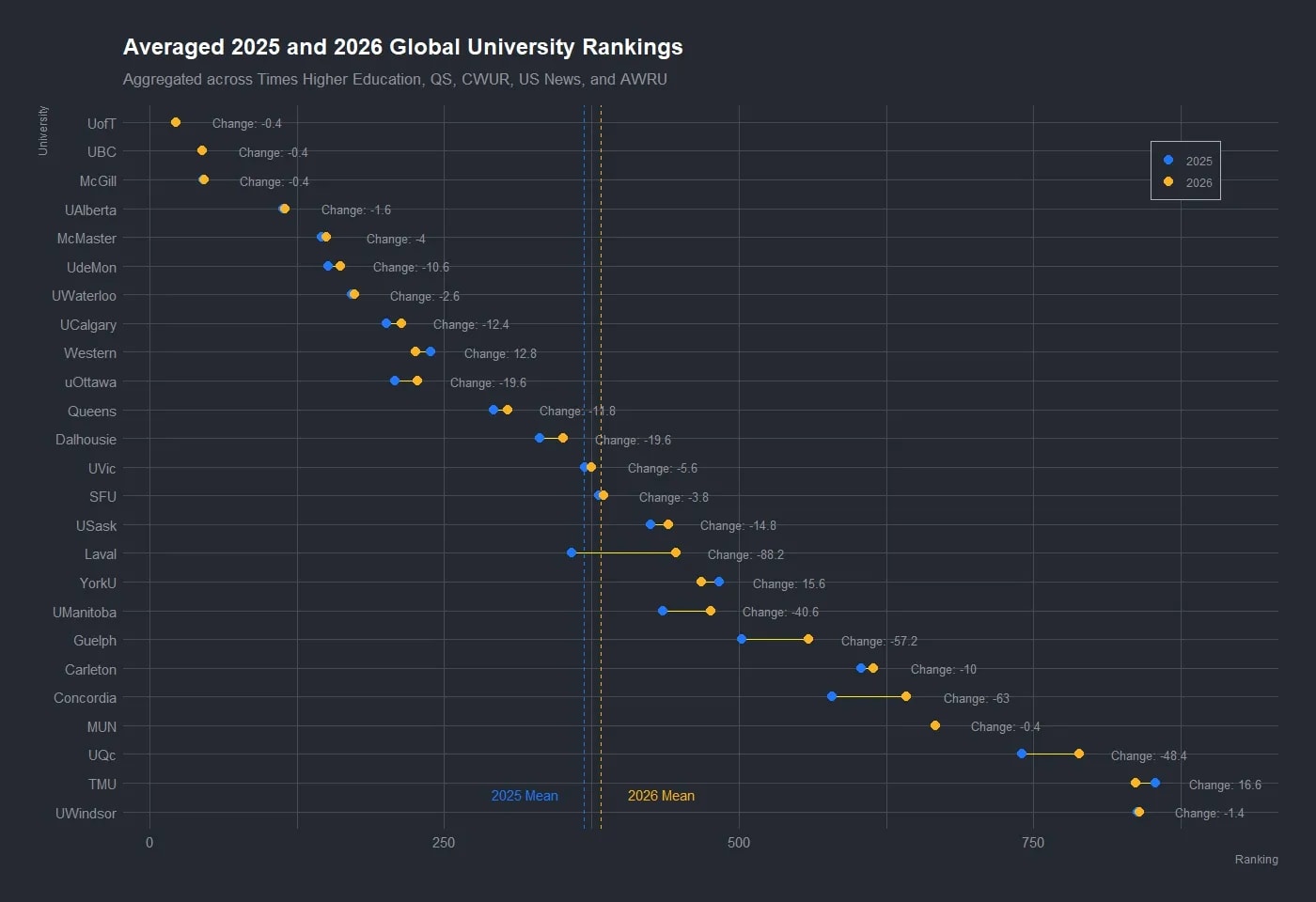
Change here was simply the 2026 ranking minus the 2025 ranking for each university. As shown, the initial claim which inspired this article appears to hold true when aggregating across different ranking methodologies. Across the board, we indeed see drops in global institution ranking for nearly every university included in this analysis. The only exceptions being the University of Western Ontario, York University, and Toronto Metropolitan University. Overall, we can see that that Canadian universities seem to be in a slight decline in terms of institutional rankings.
Another interesting point to be taken from this analysis is that the drop for the universities traditionally held as Canada’s prestige universities (University of Toronto, University of British Columbia, and McGill University) is minuscule. What appears to drive the overall drop in global institutional rankings for Canada are the drop in rankings for Canada’s mid- and lower-ranked universities. This would suggest that these universities are underperforming in some key indicator(s). As was mentioned previously, while each ranking system weights its indicators differently, research is consistently held as heavily-weighted category of indicators. For example, CWUR attributes 40% of its institution rankings to research and ARWUd arguably attributes 60% of its institution ranking to research. Hence, what may be an important factor that is degrading across these universities are those related to research output. When looking at research output statistics, the number of research articles published in this case, we can see that research output is very likely a strong reason.
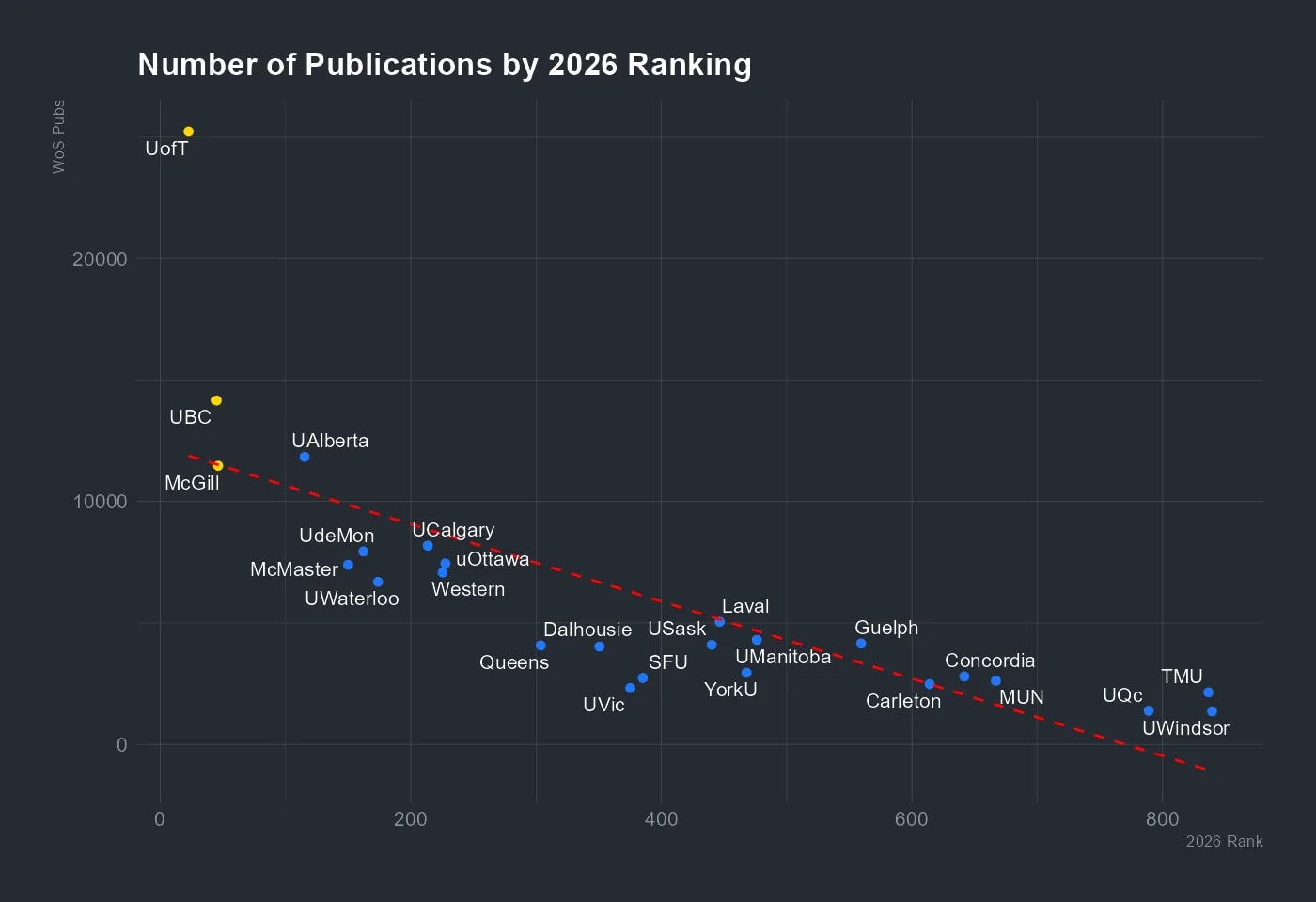
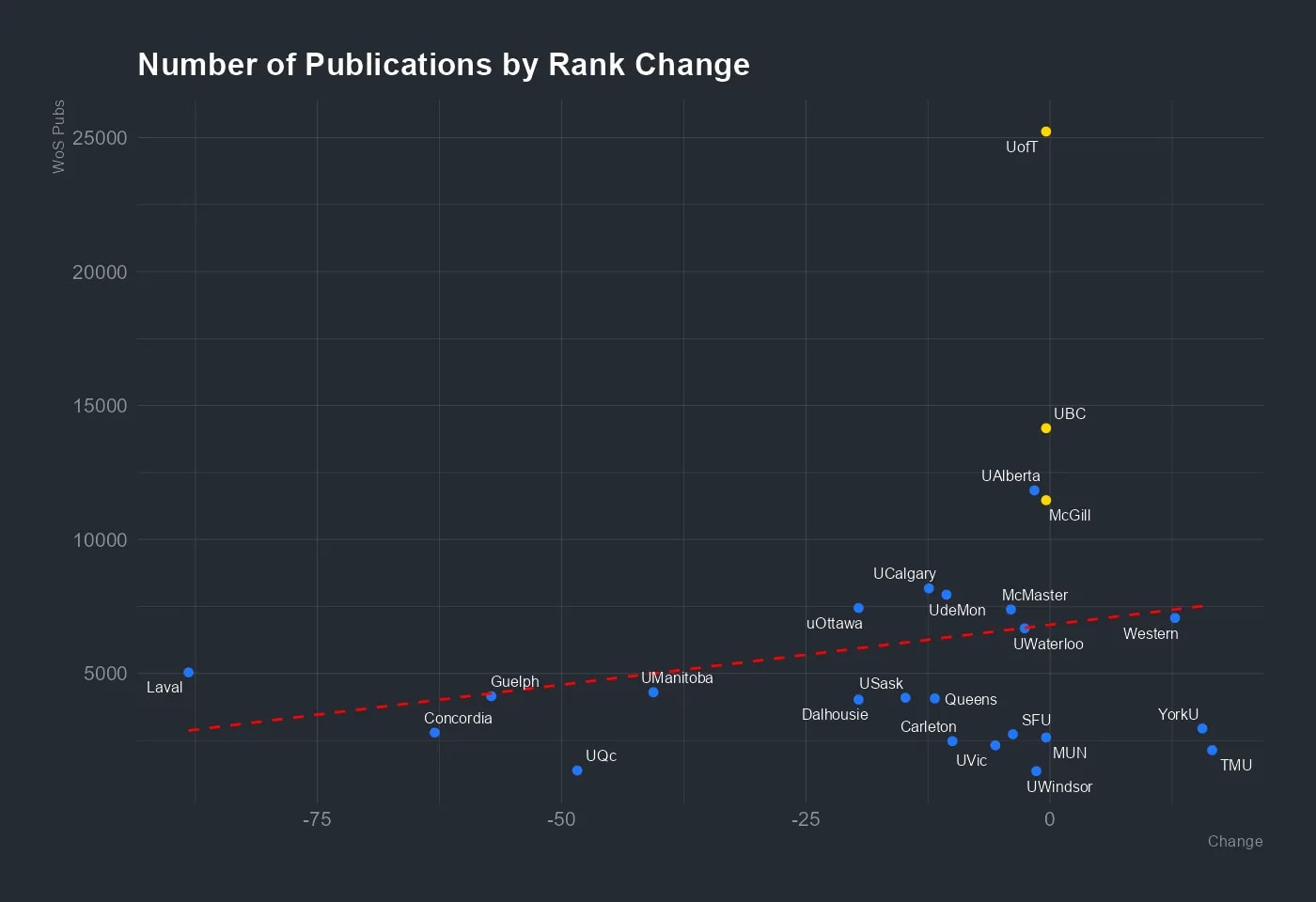
From the CWTS Leiden Ranking metrics, which provides data on research publications in World of Science (WoS) journals for institutions, we find that the University of Toronto, the University of British Columbia, the University of Alberta, and McGill University make up the four universities which published the most amount of research from 2020 to 2023. This analysis isn’t perfect as the data is a few years out of date, but as an approximation, we can see from the two scatter plots above that research output, as defined by research publications, appears to be a strong indicator of institutional ranking and rank change. And, we see a very strong negative correlation between number of WoS publications and 2026 global institutional ranking, rs = -.89, p < .001. At the very least, we can say with some confidence that the majority of Canadian universities appear to be lagging in research output. But without more recent data, it would be inappropriate to say this is definitive.
Okay, what now?
So what does it mean when nearly all Canadian universities fell in global rankings? It’s hard to say. We can say that it is true Canadian universities are falling in global institution rankings, but the more important question is why this is the case. Rankings are only aggregate indicators of the symptoms that arise from institutional goals and ambitions—they only give us a staring point for diagnosing how to fix this apparent ‘problem’. But, this may not be a problem at all. The amount and quality of research being done at a university will have very little bearing on the university experience and future for the vast majority of Canadians attending universities. After having gone through undergrad, the application process for graduate school, and finishing a master’s degree, I find myself mostly agreeing with the general sentiment surrounding institutional rankings: they’re really only useful for giving you the permission to indirectly say “Oh, I went to the Harvard of x province”.
Of course, I would be remiss to not mention that global institutional ranking is a useful proxy for several factors. More funding, more research, more prestigious researchers, better facilities, more research opportunities, etc. All of these factors are important for those with some aspiration in academic research. As an undergrad in cognitive science, I would have cherished the opportunity to be lectured by prolific academics such as Dr. Ned Block and Dr. Hakwan Lau, or burgeoning and inspiring academics such as Dr. Chaz Firestone. At the end of the day, I can forgive myself for not attending the Harvard of Ontario but the country cannot forgive itself if it allows our post-secondary institutions to fall in global metrics and perceptions.
