Research question: Does Spotify's Browse feature offer any benefits over its Search feature?
I designed a user study to evaluate the effectiveness of two music-searching features offered by Spotify, the Browse and Browse features. Results of the study showed that the Browse feature is not as effective for music-searching compared to Search, and that Browse may be better utilized as an adjacent feature.
My role included designing the experiment, creating the Qualtrics survey, and carrying out the and performing the analysis in R. See details
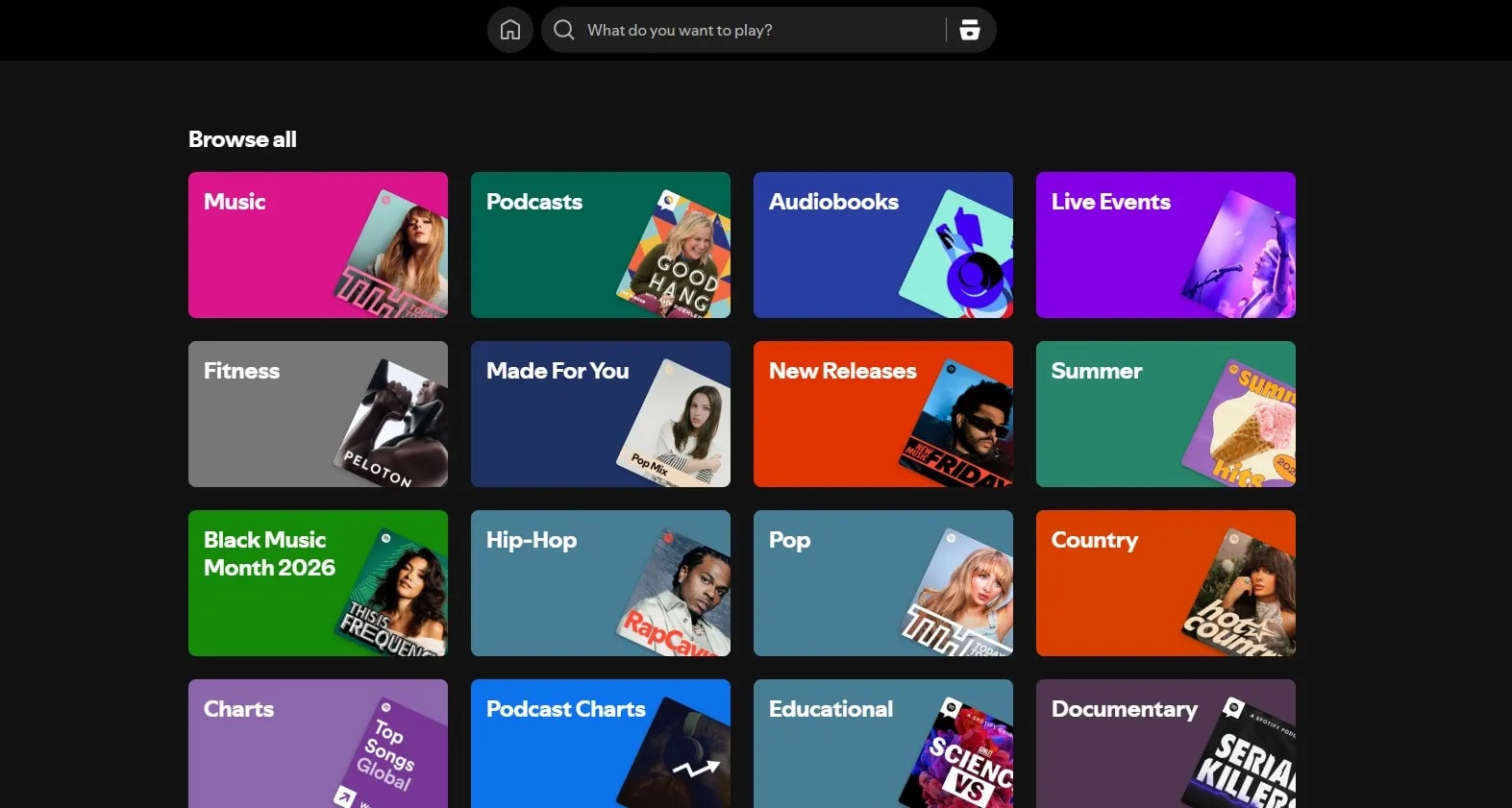
Spotify provides two features which overlap in functionality, begging the question as to why both need to exist. It's Browse and Search features allow users to browse through the platform's music library, but primarily through two distinct mediums. Browse offers a imagery-first context in which users navigate through Spotify's library in the form of higher-level folders. In contrast, Search allows users to navigate the platform's library primarily through text and is user-driven.
The overlapping functionality means that one must be redundant. It is very likely that the Spotify's Browse feature is underused by users, provides no real benefits to users, and its purpose could be redesigned to better utilize the imagery-first design. Thus, I investigated whether there was any benefit to Spotify's Browse feature over its Search feature for navigating Spotify's library.
Two features for searching through Spotify's catalogue were evaluated.

Spotify's library represented through higher level folders.

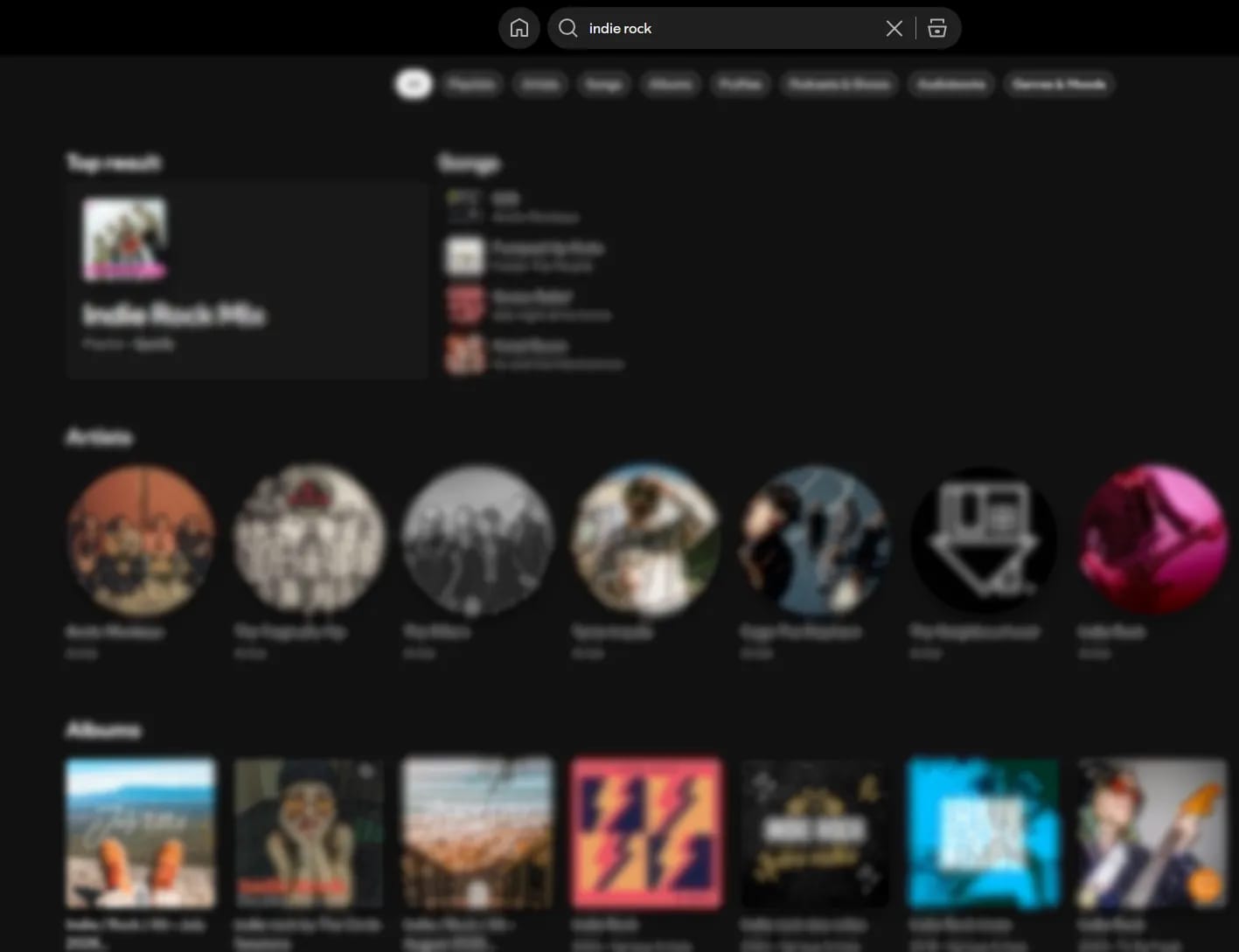
Textual search using user-entered keywords through Spotify's library.
6 participants recruited using convenience sampling. 5 with previous Spotify experience, 4 who used Spotify as their primary music streaming platform.
Create a playlist and add one songs from each of the genres provided. Each participant was provided a list of:
Within-subjects experiment where all participants experienced both features (i.e., the two conditions).
The feature order and "hard" genre were informally randomized (three levels as stated above) between participants, but was not included as variable in the analysis.
Quantitative: Search time.
Subjective: NASA-TLX scores from a modified NASA-TLX questionnaire to measure cognitive workload and feature preference.
Single seemed to produce the fastest keypress response while Stoplight seemed to produced the slowest.
Stoplight was rated with the highest mean NASA-TLX score, suggesting it might be the most workload-inducing design.
Accuracy was nearly equitable across designs, but Direction appeared to produce the most accurate keypresses.
Participants completed the task nearly two-times faster using the Search feature (147.2s).
Was the task possible just using the Browse feature?
I anticipated that the "hard" genres would be too difficult to achieve using just the Browse feature. Thus, I asked if participants switched to using the Search feature to complete the task.
The overwhelming majority of participants (80%) had to switch to the Search feature when finding a song for the "hard" genre.
The NASA-TLX was modified to a 7-point scale and the removal of the physical demands subscale to better fit the context.
Using the Search feature (3.96) produced less cognitive workload than using the Browse feature.
Lower is better.
We asked which feature participants preferred to use to explore Spotify's library both pre- and post-study.
In both cases, the Search feature was the preferred method, but post-study, preference for the Browse feature grew (20% to 40%).
What was learned about Spotify's Browse and Search features.
Browse provides no benefit over Search for user-driven navigation of Spotify's library. This is almost certainly attributed to the navigation being dictated by the catalogue hierarchy when using Browse. In contrast, Search allows for more flexible navigation as it is the user which dictates what content is retrieved and seen.
But, this is also a downside of Search, navigation requires intention and prerequisite knowledge of what is to be searched. Discovering new music with Search can thus be more difficult as new music can elude user prior knowledge. In this respect, Browse may provide more benefits for the platform if utilized as a feature for discovering music.
Navigation of Spotify's library through Browse is constrained by the categories preset by the platform. This means users are funnelled toward specific content, or genres, which may not align with their intentions or fulfill their goals. This was demonstrated by the performance losses and the fact that most participants resorted to using Search for the hard genre when undertaking the task initially using Browse. Finding more obscure or specific content is very difficult, or impossible due to the constraints laid upon Browse.
Search contrasts Browse primarily by retrieving content that is directly related to the user's goals or intentions, most of the time. But, this is done by user-driven search where the user provides a keyword(s) which triggers content retrieval. However, the user requires some prerequisite knowledge of the content they want to retrieve, and the exact content must be specified. This can include artist names, album titles, or song titles.
While the visual design of Browse constrains music retrieval, it may be of benefit for music discovery. One can imagine that the current approach can be utilized to visually direct users through more specific or obscure sub-genres of higher-level genres. For example, from "Electronic Music" to "Outsider House". The use of imagery and facilitate visual search and empower motivation, through interesting designs. This would allow users to visually discover new music in Spotify's catalogue in a relatively quick manner without needing much prior knowledge.
As has been demonstrated and discussed, Search primarily benefits Spotify as a music retrieval feature. Browse, which has been used a redundancy feature for Search, provides no benefits for music retrieval. Instead, its design philosophy can lend itself well to a music discovery function. By pivoting Browse to a music discovery feature, Spotify can provide a richer user experience for navigating and engaging with its music library.